Questions about GrazeNet
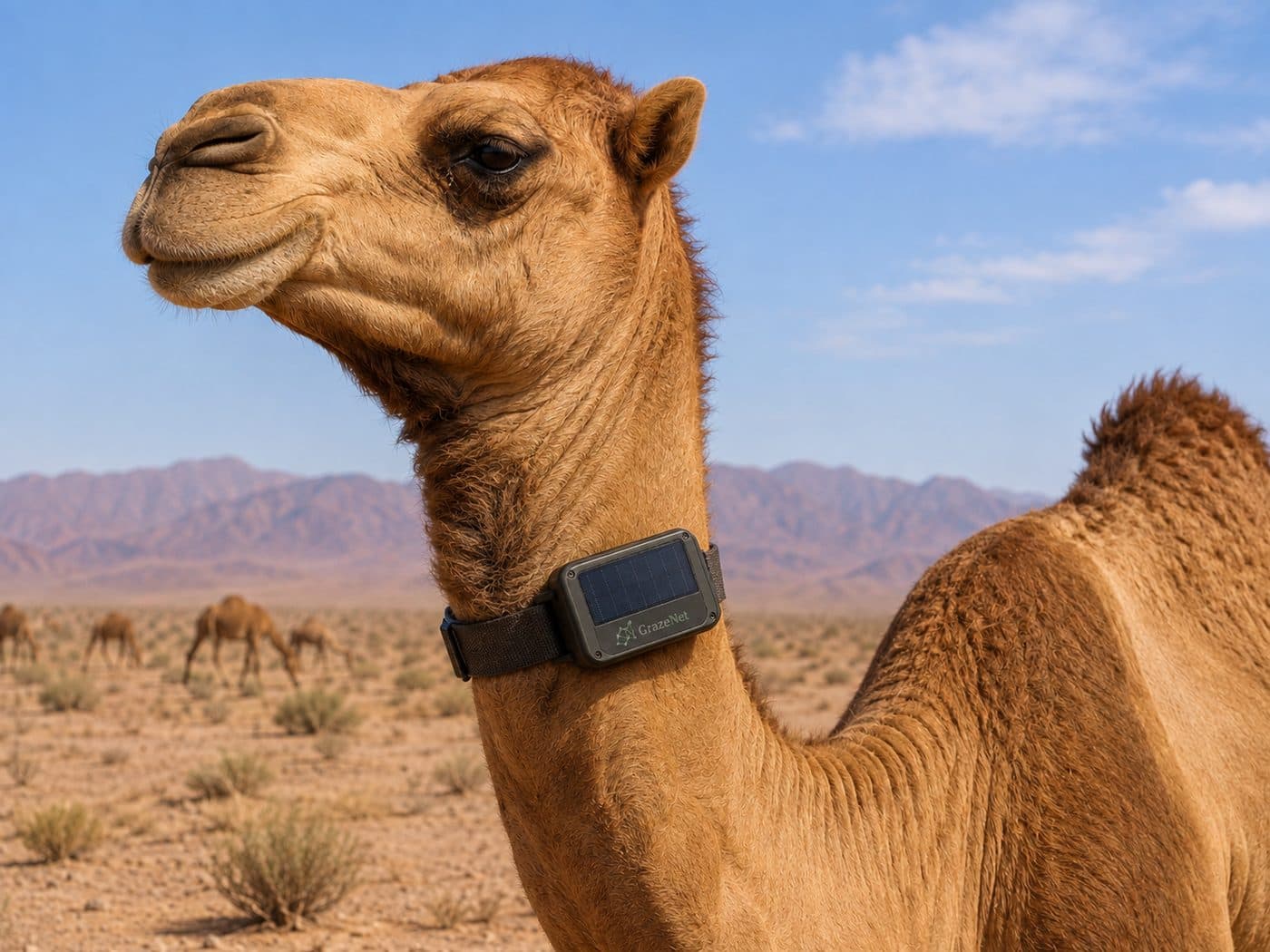
GrazeNet is a livestock tracking system. A solar-assisted collar on each animal, your herd on a map, and a message when something needs your attention.
GrazeNet is in the prototype and validation stage, with initial livestock field trials being prepared. What follows describes how the system is designed to work. Capabilities that are planned rather than in service are named as planned.
What it is
What is GrazeNet?
- GrazeNet is a livestock tracking system for grazing herds. Each animal wears a solar-assisted GPS collar that reports where it is and how it is moving. The herd appears on a map in a web dashboard, and the person responsible for the animals gets a message when something needs attention. GrazeNet is built for camels, cattle, sheep and goats that graze over open ground, and the product is at grazenet.io.
How is GrazeNet different from a normal GPS tracker?
- Many conventional cellular trackers require each tracked animal to maintain its own cellular connection, which means a mobile subscription for every animal and a battery that has to be collected and charged. GrazeNet is built around the herd instead. Collars link to one another over a long-range radio and reach the network through gateway-capable collars, so a small number of cellular connections covers the whole herd. Each collar is solar-assisted, so it tops itself up in daylight and stays on the animal. And alerts arrive on WhatsApp, so there is no separate app for anyone to learn.
Does GrazeNet require a fixed gateway or infrastructure on the farm?
- No. The gateway moves with the herd. Gateway-capable collars take the readings from the other collars and upload them over the available cellular network, so GrazeNet needs no farm Wi-Fi, no privately installed base station and no fixed equipment anywhere across the grazing area. There is nothing to build on the ground, and nothing out there to power or maintain.
What happens when mobile coverage is weak or unavailable?
- The collars go on taking their readings whether or not a gateway can reach the network at that moment. Each collar carries persistent on-device storage, and the system is designed to hold those readings through the outage and upload them once a gateway is back in coverage, so a spell without service does not have to leave a gap in the history. Live monitoring picks up again as soon as the herd is reachable.
What animals and situations is GrazeNet designed for?
- Camels, cattle, sheep and goats grazing over open ground. GrazeNet earns its place on animals that are expensive to lose or expensive to go and check on: high-value animals and breeding stock, pregnant animals in the weeks around birth, and herds spread across ground where a visual check means driving out to look.
Connectivity and power
How does data reach the cloud?
- Each collar sends its readings over a long-range radio link to a gateway-capable collar in the herd. That collar holds the cellular connection and uploads on behalf of the group, and a herd carries more than one collar able to take the role. The path from any animal to the cloud is therefore one radio hop and one upload, with no chain of animals in between.
Does every collar need cellular service?
- No. Only a subset of collars need cellular capability. A herd shares a small number of cellular connections instead of requiring a separate mobile subscription on every animal, which is where most of the running cost of a conventional tracker sits. A deployment runs more than one gateway-capable collar, so the herd never depends on a single unit.
What happens if a gateway collar loses signal or runs low on battery?
- Another gateway-capable collar takes over. The collars track whether the one currently carrying the connection is still uploading for them, and if it stops, moves out of reach or its battery falls too low, one of the others takes the role. The handover is automatic and needs nobody to intervene in the field.
What happens when the herd spreads out or separates into groups?
- GrazeNet is designed for herds that spread out. More than one collar can carry the gateway role, so separate groups keep reporting through whichever gateway-capable collar is nearest to them. A collar that is temporarily outside radio or cellular reach keeps its readings and uploads them when it reconnects.
How far can collars communicate with each other?
- GrazeNet’s long-range radio is designed to communicate over several kilometres between a collar and its gateway in suitable conditions. It is chosen for exactly this job: covering a herd that has spread out, on a small fraction of the power a cellular link would draw. The distance you get depends on the grazing area, since open ground carries much further than broken terrain, dense vegetation or a deep wadi.
What happens when there is no sunlight?
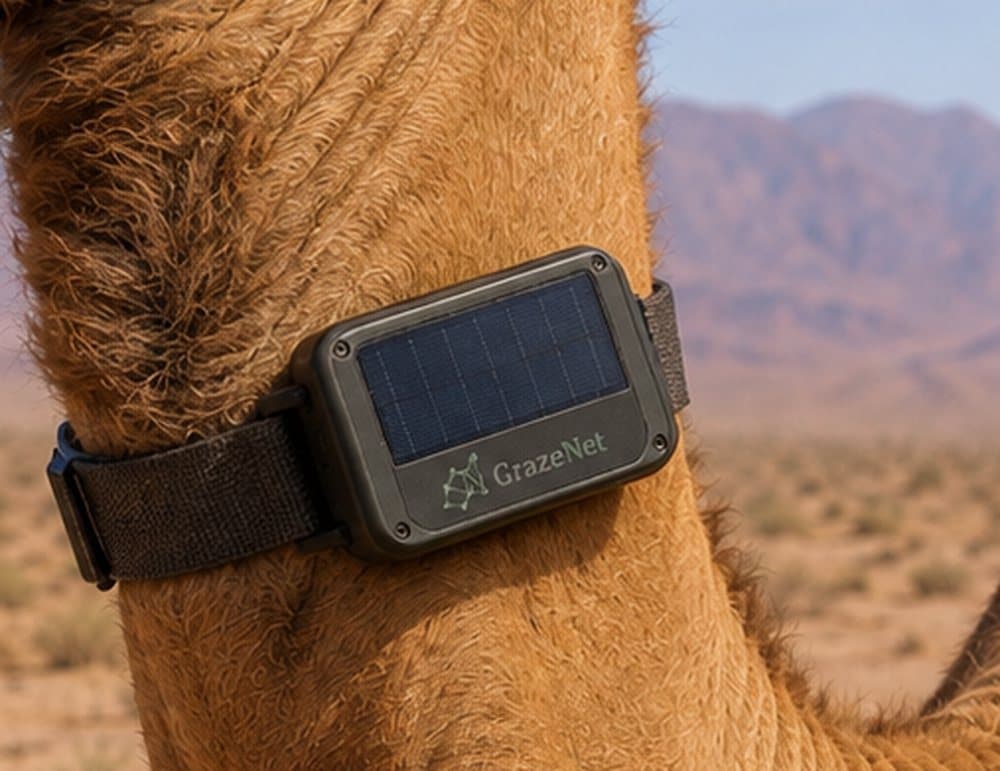
- The collar runs from its battery, and the solar panel keeps that battery topped up through the day, so nothing stops when the sun goes down. The collar is designed so that a day of reporting costs less energy than a day of sunlight returns. That is what lets it stay on the animal instead of coming off to be charged.
How long does the battery last?
- The collar is designed to stay on the animal through the grazing season, with the solar panel replacing what each day of work uses. How long it runs in a given deployment depends on how often it is set to report, how much radio traffic it carries, whether it is acting as a gateway and how much sun it gets. The reporting interval is configurable, and it is the main lever an operation has over that balance.
Tracking and alerts
What does a collar measure?
- Position, movement, acceleration and speed, the quality of the radio link between collars, the mobile signal available to gateway-capable collars, solar power coming in, battery level, collar temperature and the collar’s own health. Collar temperature means the temperature of the device: there is no body-temperature sensor and GrazeNet does not measure the animal’s temperature. Further measurements can be added where a particular operation needs them.
How often is an animal’s position updated?
- As often as the deployment needs. The reporting interval is configurable, and it is the setting that trades directly against energy: a collar reporting more often uses more power and leans harder on what the panel brings in. A herd being watched through calving can be set to report far more frequently than the same herd on open range later in the year.
How accurate is the location?
- GrazeNet positions the animal using GNSS, which under open sky places it within roughly ten to twenty metres. That is close enough to walk to the animal. Accuracy depends on the environment, so open range gives a better result than heavy tree cover or a steep valley side.
What does the dashboard show?
- The herd on a map, and every measurement each collar reports. It also goes back over the past several days, so you can follow what the herd or one particular animal has been doing: which spots they return to, how long they stay there and how that is changing. That history is presented as movement trails and as heat maps of where the herd is actually spending its time.
How does GrazeNet map mobile coverage?
- Gateway-capable collars record the cellular signal available to them as the herd moves. Over time those readings build a coverage map of the grazing area, showing where live reporting is strongest and where readings are likely to be held on the collar until the herd comes back into coverage. The herd maps the network conditions across the ground it actually uses, rather than the ground an operator’s coverage chart says it should.
How do alerts work?
- GrazeNet sends a WhatsApp message when one of its thresholds is crossed: an animal separating from the herd, a collar going quiet, a battery running low, a position going stale, or a weak signal. The thresholds are settings, so you tune them to your herd. You can reply in the same conversation to ask the system about the herd, and everything the alerts are based on is on the dashboard as well.
Can GrazeNet alert me when an animal moves too far from the herd?
- Yes. A separation distance is set for the herd, and GrazeNet sends a message when an animal ends up further than that from the nearest other animal. The distance is a setting, so it is tuned to how widely that particular herd normally spreads. The message names the animal and how far out it is, so you know which one to go and find. This tells you that an animal has moved away. Planned virtual fencing goes further, by giving the animal a cue at the boundary itself.
How can GrazeNet help identify an animal that needs attention?
- GrazeNet highlights changes that may warrant attention: an animal moving less than usual, separating from the herd, remaining in one place unusually long, or behaving differently from the group. This helps the person responsible for the herd decide which animal to check and where to find it. GrazeNet supports that decision. It does not replace veterinary judgement.
What happens if a collar is damaged or stops working?
- Each collar reports its own health alongside its readings, so a unit that has stopped behaving normally shows up in the dashboard, and a collar that goes silent raises an alert. A failed collar affects that animal’s reporting but does not bring down the rest of the herd network. The other collars go on reporting through whichever gateway-capable collar is active.
Field use
How many collars need cellular connectivity?
- Enough that the herd always has one within reach, plus redundancy. The number follows from herd size, how far the animals spread and the terrain between them, and it is set when a deployment is planned. Because the gateway role moves automatically between collars that can carry it, the herd is never tied to one particular animal holding the connection.
How large a herd can GrazeNet support?
- The architecture is designed for large herds. Adding animals still means adding collars, but it does not mean adding a separate cellular subscription for every animal. The shared-gateway design lets the number of cellular connections grow much more slowly than the number of animals, which is where the saving on a large herd comes from.
Is the collar suitable for heat, dust and rain?
- The collar is designed as a sealed unit for continuous outdoor use on animals, in the heat, dust and rain of the rangelands it is meant for, and to keep working across the temperature swing between a midday sun and a desert night.
Which countries and mobile networks does GrazeNet support?
- GrazeNet uses cellular IoT connectivity, and a deployment is configured for the bands and operators available in the country it runs in. Pilot hardware is set up for the local network before it ships, so the practical question in a new market is simply which operator reaches the ground the herd grazes on.
Planned capabilities
What is virtual fencing?
- A boundary defined in software instead of built on the ground. The collar knows where the boundary is and is designed to give the animal a cue as it approaches, so a fence becomes something you change in an app rather than something you move by hand. It lets grazing be rotated, and sensitive ground rested, without building anything.
What is dynamic herding?
- Guiding the herd with a boundary that moves. Using gentle sensory cues and a virtual boundary that travels, dynamic herding is designed to lead animals toward fresh grazing, water or shelter without anyone going out to drive them, and to steer a herd clear of an area where coverage or ground conditions are poor before it gets there.
Are virtual fencing and dynamic herding available today?
- Not yet. Both are planned capabilities, and neither is part of the initial trials, which are focused on tracking and connectivity. The collar architecture has been designed from the start with cue-based functions in mind, so bringing them in is a matter of completing and validating the feature, not redesigning the hardware.
Pilots
Can I buy GrazeNet today?
- Not yet. GrazeNet is in the prototype and validation stage, with initial livestock field trials being prepared. The way to get GrazeNet onto your animals now is as a pilot partner.
What does a pilot involve?
- Collars on a real herd, in the conditions the system is built for, running long enough to be worth something to both sides. You get your herd on a map and alerts on WhatsApp from the first day. GrazeNet gets to see how the collars stand up to the animals and the weather, how the herd network behaves as the animals spread out and regroup, and which parts of it the people running the herd actually use. Scope, duration and herd size are agreed case by case.
How can I take part?
- GrazeNet is looking for livestock owners, farms, researchers and organisations interested in participating in early field pilots. If that is you, or you would like to be kept informed as the trials progress, get in touch by email at contact@grazenet.io or on WhatsApp.
About GrazeNet
Interested in a pilot?
Something not answered here? see what the collars do.